Pregnancy brings many exciting moments, along with questions about your baby's growth and development. One important first-trimester screening test is the nuchal translucency (NT) scan, which helps assess the chance of certain chromosomal conditions and may provide information about early fetal development.
If your doctor has recommended an NT scan in pregnancy, you may want to know what it checks, when it should be performed, how to understand the report and what happens if the measurement is higher than expected.
This guide explains the NT scan, its timing, normal measurements, procedure, cost in India and the next steps after an abnormal result.
What Is an NT Scan in Pregnancy?
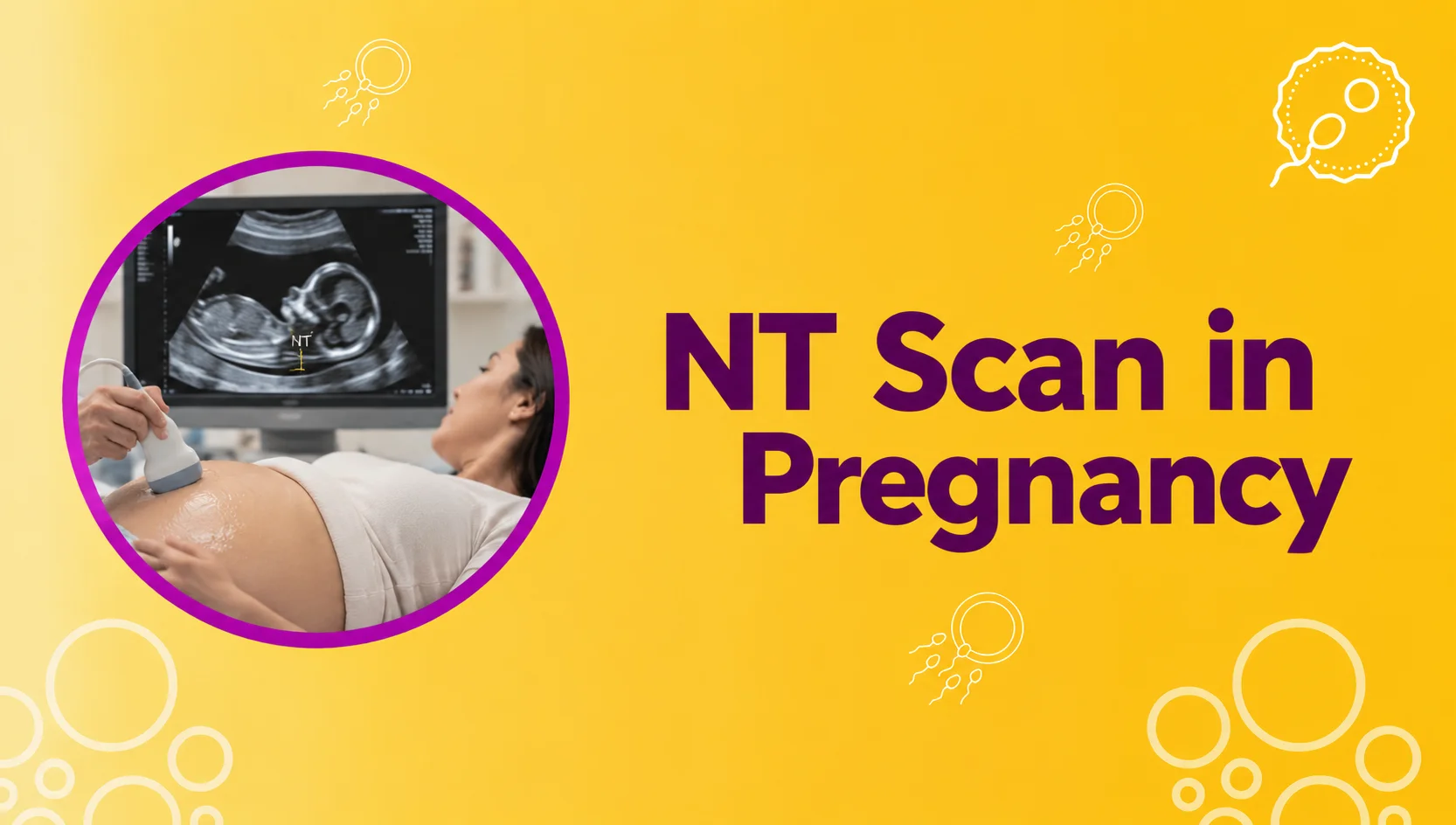
An NT scan, or nuchal translucency scan, is a specialised ultrasound performed during the first trimester of pregnancy. It measures the small fluid-filled space at the back of the developing baby's neck.
The measurement is used, along with other relevant information, to estimate the chance of certain chromosomal conditions, including:
-
Down syndrome, also known as trisomy 21
-
Edwards syndrome, also known as trisomy 18
-
Patau syndrome, also known as trisomy 13
The NT scan is a screening test, not a diagnostic test. It estimates the likelihood of certain conditions but cannot confirm whether a baby has a chromosomal condition.
A result within the expected range can be reassuring, but it cannot rule out every chromosomal or structural condition. If the result indicates an increased chance, your doctor may recommend further screening or diagnostic testing.
When Is the NT Scan Done During Pregnancy?
The NT scan is usually performed between 11 weeks and 13 weeks plus 6 days of pregnancy, provided the baby's crown-rump length (CRL) is within the accepted measurement range, generally 45 to 84 mm.
This timing is important because the baby must be at the appropriate developmental stage for an accurate NT measurement.
Your doctor or sonographer will confirm whether the scan can be performed based on your pregnancy dates and the baby's measurements.
If you miss this window, speak to your obstetrician about alternative screening options. The appropriate next step depends on your gestational age, previous test results and individual circumstances.
Why Is the NT Scan Important?
The NT scan provides information that can help your healthcare team plan appropriate prenatal screening and follow-up.
1. Estimates the Chance of Certain Chromosomal Conditions
The NT measurement contributes to an assessment of the chance of conditions such as Down syndrome, Edwards syndrome and Patau syndrome. Depending on the screening pathway, this assessment may also include maternal age, gestational age and blood test results.
2. Provides Information About Early Fetal Development
The scan assesses the baby's size and may allow the sonographer to examine some early anatomical features. The extent of this assessment depends on the baby's position, gestational age and image quality.
The NT scan does not replace the detailed fetal anomaly scan usually offered later in pregnancy.
3. Helps Determine Whether Further Testing Is Needed
If the screening result indicates an increased chance of a chromosomal condition, your doctor may discuss additional options, such as non-invasive prenatal testing (NIPT) or diagnostic tests.
The aim is to provide information that helps you make informed decisions with your healthcare team.
How Is the NT Scan Performed?
An NT scan is an ultrasound examination that uses sound waves to create images of the developing baby. It does not use ionising radiation.
The procedure usually involves the following steps:
-
Positioning: You will lie on an examination bed while the sonographer prepares for the scan.
-
Applying gel: A small amount of ultrasound gel is applied to your abdomen.
-
Taking images: The sonographer moves an ultrasound probe over your abdomen to obtain clear images of the baby.
-
Measuring the NT: The sonographer measures the fluid-filled space at the back of the baby's neck and records the crown-rump length.
-
Reviewing the findings: The measurements and any other relevant observations are reviewed as part of your prenatal screening.
The scan may take approximately 15 to 30 minutes, although the duration can vary. If the baby's position makes the measurements difficult, you may be asked to change position or walk briefly. A transvaginal ultrasound may occasionally be considered if clinically appropriate.
The scan is generally painless, although you may feel slight pressure from the ultrasound probe.
What Is the Normal NT Scan Range?
The NT measurement is recorded in millimetres. There is no single measurement that should be interpreted in isolation for every pregnancy. The expected range depends on factors including gestational age and crown-rump length.
A measurement that is higher than expected for the baby's size may be associated with an increased chance of certain chromosomal conditions or other fetal abnormalities.
Your doctor will interpret the measurement alongside the rest of the screening information rather than relying only on a single number.
What Does a High NT Measurement Mean?
An increased NT measurement does not automatically mean that your baby has a chromosomal or structural condition.
Depending on the measurement and the overall findings, your doctor may recommend:
-
Reviewing the scan findings and confirming that the measurement is appropriate.
-
Combining the NT measurement with relevant blood test results.
-
Considering NIPT or another appropriate screening test.
-
Discussing diagnostic testing or specialist assessment when indicated.
-
Arranging additional ultrasound examinations or follow-up.
Some babies with an increased NT measurement do not have a chromosomal condition. However, the finding should be discussed with your obstetrician so that the appropriate follow-up can be planned.
What Does a Low or Normal NT Measurement Mean?
An NT measurement within the expected range is generally reassuring because it is associated with a lower chance of certain conditions.
However, a normal NT measurement does not guarantee that the baby has no chromosomal or structural conditions. Continue with the prenatal screening and ultrasound examinations recommended by your healthcare team.
NT Scan With a Double Marker Test
The NT scan may be combined with a first-trimester blood test, often called a double marker test or part of combined first-trimester screening.
The blood test commonly measures:
-
Pregnancy-associated plasma protein A (PAPP-A)
-
Free beta-human chorionic gonadotropin (free beta-hCG)
These results can be assessed alongside the NT measurement and other relevant factors to estimate the chance of selected chromosomal conditions.
The combined screening result provides a risk estimate rather than a definitive diagnosis. Your doctor will explain what the result means and whether any further testing is appropriate.
What Happens If the NT Scan Result Is Abnormal?
An abnormal or increased NT measurement can understandably cause concern. However, it is important not to interpret the result as a confirmed diagnosis.
Your doctor may discuss the following options depending on your individual findings.
1. Non-Invasive Prenatal Testing (NIPT)
NIPT is a blood test that analyses cell-free DNA in the pregnant person's blood to screen for certain chromosomal conditions. It is a screening test and does not confirm a diagnosis.
2. Chorionic Villus Sampling (CVS)
CVS is a diagnostic procedure that involves collecting a small sample of placental tissue for genetic testing. It is generally performed during the first trimester when clinically appropriate.
3. Amniocentesis
Amniocentesis involves collecting a small sample of amniotic fluid for diagnostic testing. It is generally performed from around 15 weeks of pregnancy, depending on the clinical circumstances.
CVS and amniocentesis are invasive procedures with specific risks and benefits. Your doctor or genetic counsellor can explain which options are suitable for your situation.
Important: An increased NT measurement alone does not confirm a fetal abnormality. Discuss the complete screening result and available options with a qualified healthcare professional before making decisions.
What Is the Cost of an NT Scan in India?
The cost of an NT scan in India varies according to the city, healthcare facility, scan requirements and whether additional first-trimester screening tests are included.
The original article cites an approximate range of ₹1,000 to ₹3,000 for an NT scan. This is an indicative estimate, not a guaranteed current price. Confirm the current fee directly with the diagnostic centre or hospital.
If a double marker test or other screening is recommended, ask whether its cost is included or charged separately.
Is an NT Scan Necessary After IVF or IUI?
Yes. An NT scan may be recommended during IVF, IUI and naturally conceived pregnancies as part of routine first-trimester prenatal screening.
Conceiving through fertility treatment does not remove the need for appropriate pregnancy screening. The same general principles apply, although your doctor may tailor the follow-up plan to your medical history and pregnancy.
If you conceived through IVF or IUI, continue your scheduled antenatal appointments and discuss the timing of your NT scan with your obstetrician.
Is the NT Scan Safe for the Mother and Baby?
An NT scan uses ultrasound waves rather than ionising radiation. Diagnostic ultrasound is widely used in pregnancy, and when performed for appropriate medical reasons by trained professionals, it is considered safe.
The scan is non-invasive and generally painless. It does not involve inserting a needle into the uterus or taking a sample from the baby.
Follow your healthcare provider's instructions and attend the scan within the recommended time window to help obtain the necessary measurements.
How to Prepare for an NT Scan
Preparation instructions can vary between facilities. Before your appointment, consider the following:
-
Confirm your appointment: Check that your pregnancy dates fall within the recommended NT scan window.
-
Ask about your bladder: Some facilities may request a moderately full bladder, while others may not. Follow the instructions given by your scan centre.
-
Wear comfortable clothing: Choose clothing that allows easy access to your abdomen.
-
Bring previous reports: Carry your earlier ultrasound reports, pregnancy records and relevant blood test results.
-
Ask questions: Discuss any concerns about the procedure, screening results or possible follow-up with your healthcare team.
Fasting is generally not required for the ultrasound itself, but confirm whether any accompanying blood test has separate preparation requirements.
What If You Miss the NT Scan Window?
If you miss the recommended NT scan window, contact your obstetrician rather than assuming that screening is no longer possible.
Depending on your stage of pregnancy and clinical circumstances, your doctor may discuss NIPT, other appropriate screening tests or later ultrasound examinations.
A later scan cannot necessarily reproduce the same NT measurement, so your healthcare team will advise you on the most suitable alternatives.
Conclusion
The NT scan in pregnancy is an important first-trimester screening examination that measures the fluid-filled space at the back of the baby's neck. It helps estimate the chance of certain chromosomal conditions and may provide information about early fetal development.
The scan is generally safe and painless, but its results must be interpreted in context. A normal result does not rule out every condition, and an increased measurement does not automatically mean that something is wrong.
Attend your appointment within the recommended window, discuss the findings with your obstetrician and complete any additional screening or follow-up recommended for your pregnancy.
Frequently Asked Questions About NT Scan in Pregnancy
1. What is an NT scan in pregnancy?
An NT scan is a first-trimester ultrasound that measures the fluid-filled space at the back of the baby's neck. It helps estimate the chance of certain chromosomal conditions but does not provide a definitive diagnosis.
2. When should I get my NT scan?
The NT scan is usually performed between 11 weeks and 13 weeks plus 6 days of pregnancy, when the crown-rump length is generally between 45 and 84 mm.
3. What is the normal NT measurement at 12 weeks?
There is no single measurement that should be used without considering the baby's size and gestational age. Your doctor will interpret the NT measurement using the appropriate reference range and the rest of the screening findings.
4. Is an NT scan painful?
No. An abdominal NT scan is generally painless. You may feel slight pressure from the ultrasound probe. A transvaginal scan may occasionally be considered if clinically appropriate.
5. Can an NT scan detect Down syndrome?
The NT scan helps estimate the chance of Down syndrome and certain other chromosomal conditions. It cannot confirm or rule out Down syndrome on its own. Further screening or diagnostic testing may be discussed when indicated.
6. Can an NT scan determine the baby's gender?
The purpose of an NT scan is to assess early pregnancy development and screen for selected conditions, not to determine the baby's sex. In India, prenatal sex determination and disclosure are prohibited by law.
7. What happens if the NT measurement is high?
An increased measurement may indicate a higher chance of certain chromosomal or structural conditions, but it does not confirm that a condition is present. Your doctor may recommend further screening, diagnostic testing or specialist follow-up.
8. Is a double marker test necessary with an NT scan?
A double marker test may be offered as part of combined first-trimester screening. Whether it is appropriate depends on your screening pathway and the tests already performed. Your doctor can explain the options.
9. Is the NT scan necessary after IVF?
An NT scan may be recommended after IVF as part of routine prenatal screening. Fertility treatment does not replace the need for appropriate pregnancy screening and antenatal care.
10. What is the cost of an NT scan in India?
The original article gives an indicative estimate of ₹1,000 to ₹3,000. Actual prices vary by location, facility and whether additional tests are included, so confirm the current cost with your provider.
Medical disclaimer: This article is intended for educational purposes and does not replace individual medical advice.
11. Do I need to fast before an NT scan?
Fasting is generally not necessary for the ultrasound itself. If a blood test is scheduled at the same appointment, check the preparation instructions provided by your healthcare facility.
12. What should I do if I miss my NT scan?
Contact your obstetrician to discuss alternative screening options based on your current gestational age, medical history and previous test results.