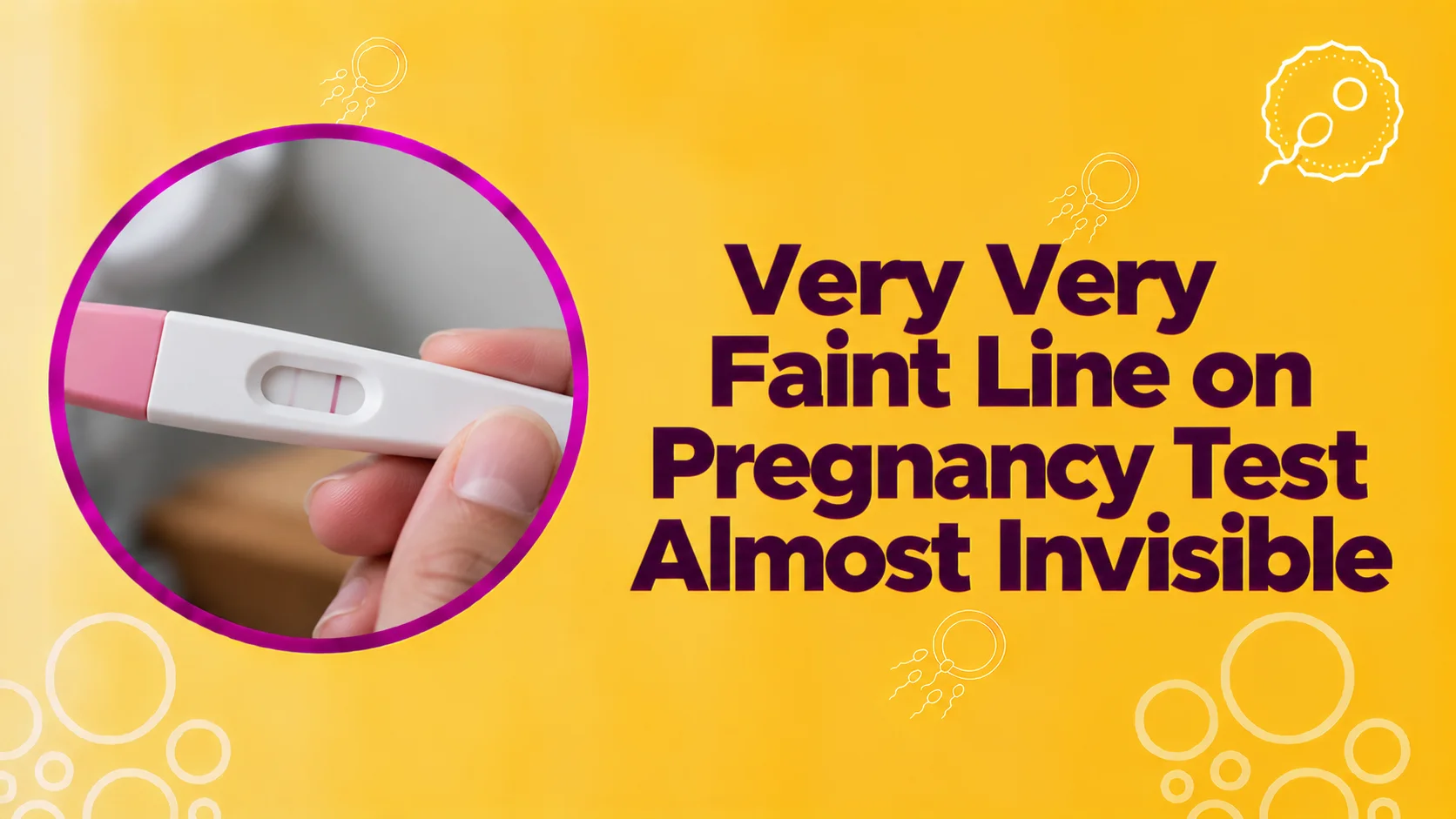
Seeing a very very faint line on a pregnancy test that is almost invisible can be confusing. You may wonder whether you are pregnant, whether you tested too early, or whether the second line is simply an evaporation mark.
A very faint coloured second line can indicate pregnancy if it appears within the pregnancy test manufacturer's recommended reading time and the control line is present. However, a faint line alone cannot confirm how a pregnancy is progressing. Evaporation lines, indent marks and incorrect test use can also cause confusion.
The result may depend on when you test, the concentration of human chorionic gonadotropin (hCG) in your urine, your ovulation timing and the sensitivity of the test kit.
In this guide, learn what an almost invisible pregnancy test line means, how to distinguish a possible positive result from an evaporation line, when to repeat the test and when to seek medical advice.
Very Very Faint Line on Pregnancy Test Almost Invisible: What Does It Mean?
A very faint line on a pregnancy test may indicate early pregnancy. When hCG is near the test's detection threshold, the second line may appear much lighter than the control line.
A very faint line may indicate a positive result when:
-
It appears in the designated test area.
-
It has the expected dye colour for the test.
-
It appears within the manufacturer's recommended reading window.
-
The control line is visible.
-
The test has been used according to its instructions.
The test line does not need to be as dark as the control line to indicate a possible positive result.
However, a grey or colourless mark, or a line that appears only after the permitted reading time, is not reliable evidence of pregnancy. If you are unsure whether the line is genuine, repeat the test with a new kit or speak with a healthcare professional.
Important: the darkness of a pregnancy test line cannot establish whether a pregnancy is healthy or progressing normally.
What Does a Faint Line on a Pregnancy Test Look Like?
Most line-based home pregnancy tests have two indicators:
-
Control line (C): Shows that the test has functioned correctly.
-
Test line (T): Indicates a possible positive result when a valid coloured line appears.
The control line should be present for the result to be valid.
| Pregnancy test appearance | What it may mean |
|---|---|
| Only the control line appears | Negative at the time of testing, although testing too early can produce a false negative |
| Control line and a faint coloured test line appear within the reading window | Likely positive |
| Two clearly visible coloured lines appear | Positive, provided the test is valid |
| A grey or colourless second mark appears | May be an indent or another test artefact |
| A second line appears only after the reading window | Unreliable result |
| The control line does not appear | Invalid test; repeat with a new kit |
Follow the instructions for your particular test brand because reading times and procedures can differ.
What Causes a Very Very Faint Line on a Pregnancy Test?
Several factors can explain why a pregnancy test line appears extremely light.
1. Taking the Pregnancy Test Too Early
Testing before your expected period is a common reason for a faint result.
Early in pregnancy, hCG may be present at a concentration that the test can detect only weakly. Testing closer to or after the first day of your missed period generally improves reliability.
If your first test is negative or unclear but your period does not arrive, repeat the test after a few days according to the kit instructions.
2. Low hCG Concentration
A faint line may appear when the concentration of hCG in urine is relatively low.
hCG levels vary between pregnancies and change over time. A test line's darkness is not a reliable way to measure the hormone level or determine whether the pregnancy is developing normally.
If a clinician needs to assess hCG levels, a quantitative beta-hCG blood test may be appropriate.
Read more about hCG levels at 4 weeks of pregnancy.
3. Diluted Urine
Drinking a large amount of water before taking a pregnancy test can dilute your urine. This may make hCG more difficult to detect, particularly when testing early.
First-morning urine may be helpful when testing around the time of your expected period because it is often more concentrated.
Avoid deliberately drinking excessive amounts of water before testing.
4. Delayed Ovulation
Ovulation does not occur on exactly the same day in every menstrual cycle.
If you ovulate later than expected, implantation and the subsequent rise in hCG may also occur later. As a result, a pregnancy test may remain negative or show a faint line even when you thought your period was due.
This can be particularly relevant if your menstrual cycles are irregular.
5. Different Pregnancy Test Sensitivities
Not all home pregnancy tests detect the same concentration of hCG.
One brand may produce a faint positive result while another remains negative, particularly when testing early. Differences in test sensitivity, expiry dates, storage conditions and how the test is used may affect the result.
Use a new, unexpired kit and follow its instructions carefully.
6. Evaporation or Indent Lines
An evaporation line may become noticeable as urine dries on a test. An indent mark may also be visible where the test line is designed to develop.
These marks can resemble a very faint positive result, but they do not independently confirm pregnancy.
Check the result only within the manufacturer's recommended reading window. If the result remains unclear, use a new test rather than interpreting a mark that appears later.
Light Pink Line on a Pregnancy Test: Does It Mean Positive?
A light pink second line can indicate a positive result when it appears in the correct test area within the recommended reading time and the control line is visible.
The line may be pale when hCG is near the test's detection threshold. However, colour alone cannot always distinguish a genuine positive result from a test artefact.
If you see a light pink line:
-
Check that it appeared within the specified reading window.
-
Confirm that the control line is visible.
-
Check that the line is in the designated test area.
-
If uncertain, repeat the test with a new kit after approximately 48 hours, following the instructions.
-
Seek medical advice if results remain inconsistent or you have concerning symptoms.
A light pink line does not, by itself, indicate a problem with the pregnancy.
Faint Positive Pregnancy Test vs Evaporation Line
A faint positive and an evaporation line can look similar, particularly when the second mark is almost invisible.
| Feature | Possible faint positive | Possible evaporation or indent line |
|---|---|---|
| Appearance | Usually has the expected dye colour | May appear grey, colourless or like a shadow |
| Timing | Appears within the permitted reading window | May become noticeable after the reading window |
| Meaning | Can indicate hCG detection | Does not confirm pregnancy |
| What to do | Follow up with repeat testing if needed | Repeat with a new kit if the result is uncertain |
These visual differences are not definitive in every case. Follow the test manufacturer's instructions rather than relying on colour or appearance alone.
If only one line is visible during the recommended reading period and a second mark appears after the test has been left aside, do not treat that later mark as a confirmed positive result.
I Got a Very Faint Line on a Pregnancy Test. What Should I Do?
An almost invisible second line does not necessarily mean something is wrong. These steps can help you decide what to do next.
Step 1: Check the Reading Time
Look at the result only during the reading window specified in the instructions. A mark that appears after that period should not be interpreted as a reliable positive result.
Step 2: Check the Control Line
If the control line is missing, the test is invalid. Repeat the test with a new kit.
Step 3: Repeat the Test After Approximately 48 Hours
If the result is unclear and you have no concerning symptoms, you can repeat the test after approximately 48 hours.
Use a new kit and follow the instructions. First-morning urine may help when hCG levels are low.
The second line may become more visible, remain faint or disappear. These changes cannot reliably determine pregnancy viability, so do not rely on line darkness alone.
Step 4: Consider a Beta-hCG Blood Test
If home pregnancy tests repeatedly give conflicting results, a healthcare professional may recommend a quantitative beta-hCG blood test.
Depending on the result, your symptoms and how far along you may be, the clinician may recommend repeat blood testing or an ultrasound.
Step 5: Consider Your Fertility Treatment History
If you have recently undergone fertility treatment, the timing of testing matters. An hCG trigger injection can cause a temporary positive home pregnancy test.
Follow the testing schedule given by your fertility specialist. For more information, read when to take a pregnancy test after IUI.
How Many Weeks Pregnant Are You With a Very Faint Line?
A very faint pregnancy test line cannot tell you exactly how many weeks pregnant you are.
In a typical 28-day menstrual cycle, a positive test around the time of a missed period may occur at approximately four weeks of pregnancy. However, ovulation timing, cycle length, implantation and test sensitivity can change when a positive result appears.
Gestational age is generally calculated from the first day of your last menstrual period, not from the darkness of a pregnancy test line.
You can use the pregnancy calculator to estimate your pregnancy dates. A healthcare professional can help confirm the timing and determine whether further assessment is needed.
Can a Very Faint Pregnancy Test Line Become Darker?
Yes, a faint line may become darker on a later test as hCG increases during early pregnancy.
However, the appearance of a line can also vary with urine concentration, the test brand and how the test is performed.
A darker line does not guarantee a healthy pregnancy, and a lighter line does not automatically mean pregnancy loss. Comparing home-test line darkness is not a substitute for clinical assessment.
If your healthcare professional needs to evaluate pregnancy progression, they may recommend quantitative beta-hCG testing and, when appropriate, an ultrasound.
Can a Very Faint Line Indicate a Chemical Pregnancy?
A chemical pregnancy is a very early pregnancy loss that occurs before the pregnancy can usually be identified on ultrasound.
In some cases, a person may initially have a positive pregnancy test and later receive a negative result as hCG levels decrease. Bleeding or cramps may also occur.
However, one faint positive test cannot confirm a chemical pregnancy. Differences in urine concentration, testing conditions and test sensitivity may also explain changing results.
If a positive test is followed by bleeding, persistent pain or repeated conflicting results, contact a healthcare professional for advice.
When Is the Best Time to Take a Pregnancy Test?
Home pregnancy tests are generally more reliable from the first day of a missed period.
Testing earlier can produce a negative result even when pregnancy has occurred because hCG may not yet be detectable at the level required by the kit.
If your menstrual cycles are irregular and you do not know when your next period is due, testing at least 21 days after unprotected sex is a useful general guideline.
For early testing, first-morning urine may help. Always follow the kit instructions, and repeat the test if your period does not arrive and the result is negative or unclear.
If you have had fertility treatment, follow the date recommended by your treating specialist rather than relying only on a home test.
For additional information, read when to take a pregnancy test after implantation bleeding.
When Should You Seek Medical Advice?
A faint positive result does not automatically indicate a complication. However, consider contacting a healthcare professional if you experience:
-
Repeated faint or conflicting pregnancy test results.
-
A missed period with persistent negative or unclear tests.
-
Vaginal bleeding or ongoing pelvic pain after a positive result.
-
A positive result followed by repeated negative tests.
-
Uncertainty after fertility treatment or hCG medication.
-
A history of ectopic pregnancy and a new positive test.
Seek urgent medical attention if you have severe abdominal or pelvic pain, shoulder-tip pain, fainting, significant dizziness or heavy bleeding. These symptoms can indicate an ectopic pregnancy or another condition that needs prompt assessment.
An ectopic pregnancy occurs when a pregnancy develops outside the uterus. A home pregnancy test cannot establish where the pregnancy is located. Learn about ectopic pregnancy and its warning signs.
Do not wait for a repeat home test if you have severe or worsening symptoms.
Common Myths and Facts About Faint Pregnancy Test Lines
Myth: A very faint line always means the test is negative.
Fact: A genuine coloured second line within the reading window can indicate a positive result, even if it is extremely light.
Myth: Both lines must be equally dark.
Fact: The test line may be much lighter than the control line.
Myth: A darker test line proves the pregnancy is healthy.
Fact: Line intensity cannot reliably establish pregnancy viability or measure hCG progression.
Myth: A faint positive always means miscarriage.
Fact: A faint line can occur in early pregnancy. A single result cannot diagnose pregnancy loss.
Myth: An evaporation line confirms pregnancy.
Fact: A mark that appears after the permitted reading window is not reliable evidence of pregnancy.
Myth: A faint line tells you how many weeks pregnant you are.
Fact: Pregnancy duration cannot be accurately calculated from test-line darkness.
Frequently Asked Questions About a Very Faint Pregnancy Test Line
1. Can a faint pregnancy line disappear?
Yes. A faint line may be followed by a negative result on a later test. This can happen because of differences in urine concentration or testing conditions, or because hCG levels have decreased following a very early pregnancy loss. A single change in test results cannot establish the cause. If you have a positive test followed by a negative result, consult a healthcare professional if you need clarification or have symptoms.
2. Can a faint line on a pregnancy test still be negative?
Yes. A mark that looks like a faint line may be an indent or evaporation line rather than a true positive. However, a coloured second line that appears within the manufacturer's recommended reading window can indicate pregnancy, even when it is almost invisible. If you are unsure, repeat the test with a new kit according to its instructions.
3. What is the difference between a faint line and an evaporation line?
A faint positive line generally has the expected dye colour and appears in the test area within the recommended reading window. An evaporation line may appear as urine dries, often after the permitted reading time, and may look grey or colourless. These visual differences are not always conclusive, so follow the test instructions and repeat the test if the result is unclear.
4. Is it possible not to be pregnant with a faint line?
Yes. An apparent faint line does not always indicate pregnancy. It may be an evaporation line, an indent mark or an incorrectly interpreted result. Certain fertility medications containing hCG and a recent pregnancy can also affect test results. If a coloured second line appears within the reading window, treat it as a possible positive and seek confirmation if needed.
5. What is a 2-finger test in pregnancy?
The term "2-finger test" is sometimes used to describe an informal or traditional method involving inserting two fingers into the vagina to assess the cervix. It is not a reliable way to confirm pregnancy or determine whether a pregnancy is healthy. A home pregnancy test detects hCG, while a healthcare professional may use blood tests and ultrasound when clinically appropriate. Avoid attempting internal examinations yourself to check for pregnancy.
6. Can too much urine on a pregnancy test make it positive?
Using more urine than the test instructions recommend can cause an invalid or difficult-to-read result. It does not reliably create a true positive result. Use the specified number of drops or follow the recommended dipping time for your particular test. If the test becomes flooded, the control line does not appear or the result is unclear, repeat it with a new kit.
7. How can you spot a false-positive pregnancy test?
You cannot reliably identify every false-positive result from the appearance of a home pregnancy test alone. Possible explanations include hCG-containing fertility medication, a recent pregnancy or early pregnancy loss, and incorrect interpretation of an evaporation or indent line. If a positive result is unexpected or followed by negative tests, a healthcare professional may recommend a quantitative beta-hCG blood test and further assessment based on your symptoms and history.
Conclusion
A very very faint line on a pregnancy test that is almost invisible may indicate early pregnancy when a genuine coloured second line appears within the recommended reading time.
Early testing, diluted urine, delayed ovulation and differences in test sensitivity can affect the result. Evaporation and indent lines can also cause confusion.
If the result is unclear and you have no concerning symptoms, consider repeating the test after approximately 48 hours using a new kit and following its instructions. A healthcare professional may recommend a beta-hCG blood test if results remain inconsistent.
A faint line alone cannot determine how far along you are or confirm that a pregnancy is progressing normally. If you have concerning symptoms, seek medical advice rather than relying on repeat home tests.
Medical disclaimer: This article is for general educational purposes and is not a substitute for individual medical advice, diagnosis or treatment.